FERC: Not so Fast....

FERC: Not so fast to PG&E decision on Scott Dam gates, pending review of impact on protected species

By Kate Fishman | March 29, 2023

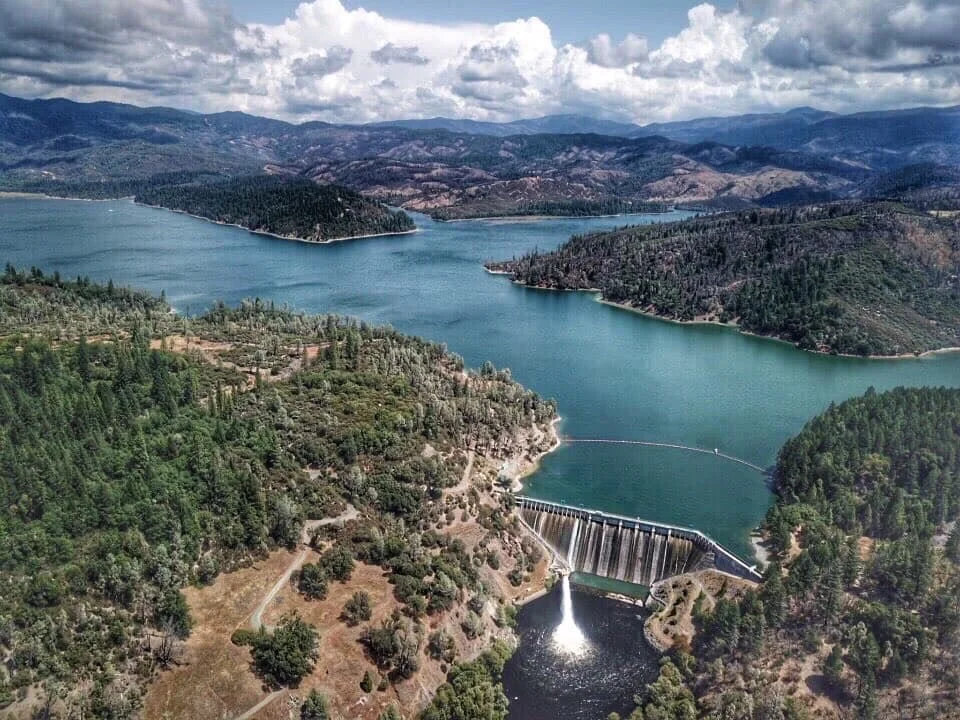
POTTER VALLEY, CA, 3/29/23 — Pacific Gas & Electric (PG&E)’s decision to leave the spillway gates open at Scott Dam this spring and in the future due to increased risk of seismic activity in the area may put the utility out of compliance with its license to operate the Potter Valley Project, according to a letter from the Federal Energy Regulatory Commission (FERC) to PG&E’s president on Tuesday. In the letter, FERC Director of Hydropower Administration and Compliance CarLisa Linton notified PG&E that the utility could violate its mandates to protect federally endangered species by reducing water storage in Lake Pillsbury so significantly (around 10 feet).

She said the utility must complete an amendment application detailing any environmental impacts of the decision, outlining planned mitigation or avoidance measures, and demonstrating consultation with relevant agencies and tribes. FERC specifically asked to see correspondence with federal and state resource agencies including the National Marine Fisheries Service, as well as “interested” non-governmental organizations and tribes — plus responses received from said entities, and PG&E’s response to that input. 

“Pending approval of an amendment application, you are required to maintain compliance with your existing license, as amended,” Linton wrote. 

Scott Dam spillway gates normally close as early as April, and FERC’s letter could impact PG&E’s approach to managing the water resource this year. Linton indicated that FERC plans to thoroughly review the amendment’s potential impacts.

“We anticipate that, before acting on any such amendment request, the Commission would have to prepare an analysis under the National Environmental Policy Act and complete ESA consultation,” she wrote. If formal ESA consultation is necessary, that process can be lengthy.

Should it be approved, PG&E’s plan to keep the spillway gates open in spring indefinitely would carry a big impact for the Russian River watershed, relied on by many in inland Mendocino County. When the news broke in mid-March, it accelerated existing concerns around water access as PG&E moves forward with developing a license surrender and decommissioning plan for the Potter Valley Project. 

“What’s being created is perpetual drought circumstances,” 3rd District Supervisor John Haschak said of the open gates in supervisors’ reports at Tuesday’s meetings. 1st District Supervisor and Board Chair Glenn McGourty pointed out that the decision makes it exponentially more necessary for Russian River water users to find alternatives for the Eel River diversions they rely on, including raising Coyote Valley Dam and pursuing water storage infrastructure in Potter Valley.

In a message to The Mendocino Voice prior to Tuesday’s letter, PG&E spokesperson Paul Moreno said that the utility has hired a consultant as part of its early decommissioning and license surrender planning schedule. 

“We do intend to reach out to stakeholders,” he wrote. 

Learn more about the Potter Valley Project’s current phase here, and read the letter from FERC below. The Voice will continue to update on the operation of Scott Dam as more information is known. 


Potter Valley Project: Russian River Water Forum forms to advise on decommissioning, Scott Dam spillway to remain open

Mendocino Voice - March 29, 2023

By Kate Fishman

MENDOCINO Co, CA, 3/26/23 — Pacific Gas and Electric (PG&E) is about eight months into a 30-month planning timeline for the license surrender of the Potter Valley Project, a system of dams and hydroelectric power that has diverted water from the Eel River to the Russian River since 1908 and made a lasting mark on the region’s productivity, environment, and lifeways. But the way forward is uncertain. In 2025, PG&E could decide that one or both of the project’s dams will be removed, the project could continue to run under a new license operator, or one of myriad options in between. 

Further, a variety of factors complicating the already controversial project have emerged — and last week, PG&E announced that the spillway gates at Scott Dam will remain open this spring and in future years due to the potential for seismic activity in the area. This will mean less water storage in Lake Pillsbury, complicating the usual systems of water flow ahead of any infrastructure changes at the dams.

Also last week, a new working group under the name of the Russian River Water Forum has been formed by local water leaders to explore ways forward for the project and to negotiate with PG&E. This new group could be viewed as a second coming of the Two-Basin Partnership, a now-dissolved initiative to form a regional entity to take over the license from PG&E that was led by Representative Jared Huffman. 

The summer’s news also remains a factor in the project’s future. After PG&E announced its decision not to renew its 50-year license from the Federal Energy Regulatory Commission (FERC), taking up an interim annual license for the duration of the project decommissioning, the National Marine Fisheries Service (NMFS) wrote to FERC saying that project operations were negatively impacting salmon and steelhead survival to an extent not permitted under the Endangered Species Act (ESA). In response, multiple local fish and fisheries advocacy groups sued FERC over unauthorized “take” of (or harm to) endangered fish

Whole landscapes and communities of Northern California have been defined and changed by the Potter Valley Project. As rancher Frost Pauli told The Mendocino Voice, his family moved to Potter Valley in the 1920s “as a direct result of water being available there for agriculture — and we’ve been farming there ever since.” 

“It’s much bigger than a single project or a single piece of infrastructure,” Frost Pauli reflected. “It’s a regional issue that affects six different counties, hundreds of thousands of people, thousands of acres of land, and of course, two huge river systems and the environment in those river systems. … [Resolution] is going to be a marathon, not a sprint.” 

Scott Dam news: the tension between infrastructure and water supply

New analyses have forecast that Scott Dam, the project’s diversion mechanism at Lake Pillsbury, is threatened by possible seismic activity, the impacts of which could be exacerbated by greater water storage. Keeping the spillway gates open is a decision made “in the interest of community safety,” due to new information as the capacity to study earthquake potential continues to advance. 

“While risks to the dam remain very low, by reducing water levels in the reservoir we can mitigate against risk,” said Jan Nimick, vice president of Power Generation at PG&E. “Storing less water in the reservoir (a 26% reduction compared to a full reservoir) lowers the water load on the dam, thereby significantly reducing the risk during or after a seismic event.” 

More water will likely flow in the Eel River this spring, but less water will be stored in Lake Pillsbury for summer and fall water releases that support cold water fisheries below Scott Dam, Russian River agricultural interests, and recreation on the lake. According to PG&E’s release, the flow to the Russian River — which the utility plans to apply for a variance from FERC to decrease — will probably mimic drought-stricken summers such as 2020 and 2021, despite our dramatic rain and snowfall this year

“Today’s announcement from PG&E makes it clear that maintaining the status quo for the Potter Valley Project is no longer an option,” fisheries advocacy nonprofit California Trout said in a statement. “We continue to encourage Russian River water users that have benefited from Eel River water diversions for the past century to plan for a future without those diversions, or to explore options for an ecologically sound, dam-free diversion facility.”

Janet Pauli, who has served on the Potter Valley Irrigation District Board of Directors since 1988 and represented the district at the Mendocino County Inland Water and Power Commission (IWPC) since 1996, said the IWPC will likely be involved in the variance request proceedings as well as looking to longer-term solutions to compensate for water storage at Lake Pillsbury.

“It’s a very serious concern, and something that we actually hadn’t anticipated at this point in time,” she said. 

Elizabeth Salomone, general manager of the Russian River Flood Control & Water Conservation District (RRFC) is charged with maintenance of 86 diversions along the Russian River (primarily for agriculture customers). Because this water is not necessarily the only supply for many of those customers, she feels that this year could go okay; they have greater reserves to draw from than after recent dry seasons. But that’s not a long-term solution. 

“If we don’t get significant rainfall in this next winter, we could be looking at some very dire circumstances,” she said. “We really can’t afford to miss another wet winter. We’re going to need above-average rainfall pretty much every winter to keep us afloat.” 

Further, Salomone says that our drier, hotter summers increase the need for irrigation and further burden the water supply. This pendulum of extremes — with a torrent of atmospheric rivers moving through California this winter — is not very conducive to stable water supply. 

“We don’t have the capacity to benefit from that as far as storage,” she said. “Our reservoirs fill up, the ground fills up, the natural waterways fill up. There’s only so many buckets and barrels you can put out. We just don’t have any more room.” 

How does the Russian River Water Forum factor in?

Between months three and eight of its schedule for establishing a decommissioning plan, PG&E had planned to “conduct initial outreach to agencies and other stakeholders to solicit relevant information for the preparation of the surrender application and decommissioning plan.” Multiple sources interviewed for this article told The Voice that PG&E had not formally engaged their organizations in discussion around the project during recent months. 

“PG&E is probably not interested in dealing with a lot of different individual entities,” Janet Pauli explained. “They want a formed, functioning regional group that represents everyone but can speak almost independently, and is capable of taking on a project that won’t be cheap to operate.”

After PG&E announced plans not to renew its 50-year license expiration, Huffman tried to answer this call with the Two-Basin Partnership. The partnership brought together California Trout, Humboldt County, IWPC, the Round Valley Indian Tribes, and Sonoma County Water Agency. It initiated discussions across a variety of different interests, and commissioned studies on solutions that would balance water supply needs; thriving ecosystems; and public health. 

But the partnership failed to meet FERC’s Apr. 14, 2022 license application deadline. 

“We prepared quite a lot of information,” Janet Pauli said. “It wasn’t as if we didn’t have anything done, but we didn’t get enough done by the end to be able to prepare a license application by the date it was required by FERC. We ran out of time and money.” 

Almost a year later, enter the Russian River Water Forum. The project’s website launched last week, created by Sonoma County Water Agency and other regional partners, with funding from the California Department of Water Resources. 

“The Water Forum will seek to identify water-supply resiliency solutions that respond to PG&E’s planned decommissioning of the Potter Valley Project while protecting Tribal interests and supporting the stewardship of fisheries, water quality, and recreation in the Russian River and Eel River basins,” the website details. “More broadly, the Water Forum will support ongoing regional collaboration on water supply and watershed restoration issues in the Russian River and Eel River basins.” 

Once its charter is finalized, the forum’s Planning Group will include 30 members from Lake, Sonoma, Mendocino, and Humboldt counties, and will hold public meetings and workshops throughout 2023

“How do we maintain some amount of diversion from the Eel to the Russian that is fair and equitable?” Salomone said, outlining the Forum’s guiding questions. “All the stakeholders can have a voice in that and raise concerns, and develop a local solution to that continued diversion, however it may look. Another focus will be general water resiliency in the watershed, [in addition to] water reliability and availability. When we do have these really difficult times, how do we sustain ourselves through them?” 

An eventual goal would be for the Forum to build capacity to carry the project forward into the next stage of its life — and as Janet Pauli points out, “speed is of the essence.” 

“We hope that a regional entity will form from the feedback and advice of this group, and then that entity will become a legal one that can begin those formal discussions with PG&E and FERC,” Salomone confirmed. “Because someone’s going to have to take over the project, the diversion in the water, and then deliver that water to the Russian River.”

What’s the best way forward? 

In the midst of these significant new developments around the Potter Valley Project’s uncertain future, a new study was published by the Bay Area Council Economic Institute forecasting the economic impact that removal of both Scott and Cape Horn dams could have on the project’s five immediate surrounding counties. 

The study’s introduction argues that removal of both dams is a likely outcome because of the “reasonable initial capital outlay for PG&E and the minimal long-term operation and maintenance costs associated with dam removal relative to long-term operations and maintenance costs coupled with ongoing state and federal liabilities surrounding fish passage, environmental compliance, and dam safety without a continued revenue source.”

According to its look at the immediate impacts of removal, the projects would support 1,037 to 1,332 full-time equivalent job years in the five-county region, and around $203 million to $278 million of economic output for that region alone. 

“There’s this paradigm of fish versus people or nature versus people that’s something that we always battle in the environmental space, because it’s just not true,” Charlie Schneider of California Trout told The Voice. “Studies like this are really helpful in showing that the removal is essentially a big construction and restoration project, and there are economic benefits to the community that come from doing that kind of work.” 

Schneider said that promoting fisheries interests can feel like an uphill battle, especially when protected fish in the Eel River system have been depleted to the tune of less than 10% of their historic populations

“Are we going to right this?” he asked. “Salmon populations are in dire shape up and down the state as evidenced by the closure of this year’s salmon season. Its important to realize the impact of that is lost jobs, lost livelihoods on the coast and a loss of part of their culture for Eel River and other tribes. There are solutions that can benefit fish and people. I think decision makers are starting to lose sight of that because that story isn’t being told anymore, because there are so few salmon fishermen. … It’s been so many bad years in a row, in part because of decisions around how we steward our rivers and whose interests get prioritized.”

For farmers in the Russian River watershed, water from the diversions is essential for agricultural supply, meaning that removal is not necessarily the obvious solution. Frost Pauli, of Pauli Ranch and the Mendocino County Farm Bureau, explained that from the bureau perspective, the status quo has been working well. But in advocating for these solutions, the volunteer-governed farm bureau favors outcomes that make sense across a variety of different interests in the century-old project.

“We are not opposed to dam removal,” Frost Pauli said. “If it makes sense for the environment, and if it makes sense for the economy, and if it makes sense for the safe operation of this infrastructure to the benefit of both basins. … If all of those concerns can be met, then dam removal makes sense.”

Janet Pauli has been involved in feasibility studies for different solutions projects, including raising Coyote Valley Dam by 30 feet, or engineering a dam at the north end of Potter Valley to augment existing storage at Lake Mendocino. 

“There’s a lot of work that still has to be done to ensure that is possible,” she explained. “And that’s what we’ve been working on.” 

“When people don’t get involved, they’re just abdicating their power”

Salomone believes that the formation of the Russian River Water Forum is an “important and significant step,” but also notes that these opportunities for engagement in the future of both basins are only as good as who shows up. 

“I attend a lot of public meetings of those who are managing water, and I rarely see the public there,” she said. “And I get it … but it’s time for folks to figure out where they’re getting their water [and] what condition their water supplier is in. Is it really stable — they have a lot of revenue and a lot of reserve, they have resiliency projects, and they have a diverse portfolio of the water sources — or are they a sole-source water supplier, and that source is threatened? I’ll tell you, in the greater Ukiah area, we have both extremes. … It’s really important for people to understand where they are on the spectrum of water reliability.” 

Janet Pauli agrees, saying “our project has never been easy in terms of discussions, because this has always been controversial.” But from her perspective, representing a diversity of interests is critical to find a viable solution. 

“It requires our diligence in moving forward,” she said. “The more voices we have at the table [the better], so we can understand the concerns of all groups, including folks on the Eel River side, Lake County, tribal members on both watersheds, environmentalists, agencies who are charged with protecting the fishery in both watersheds, water suppliers, or local government. … I’m hopeful that we will get to a place where we can continue the diversion, which is what we agreed upon in the [Two-Basin Partnership], and at the same time, be more protective of rivering conditions on the Eel, and not forget the conditions on the Russian River that are important for listed fish here as well.” 

As Salomone put it: “When people don’t get involved, they’re just abdicating their power.” 

Note: Kate Fishman covers the environment & natural resources for The Mendocino Voice in partnership with a Report For America. Her position is funded by the Community Foundation of Mendocino, Report for America, & our readers. You can support Fishman’s work with a tax-deductible donation here or by emailing publisher@mendovoice.com. Contact her at KFishman@mendovoice.com or at (707) 234-7735. The Voice maintains editorial control and independence.

Gates atop Scott Dam will not be closed this Spring or in the future....

PG&E Press Release

Water Levels at Lake Pillsbury to be Lower this year


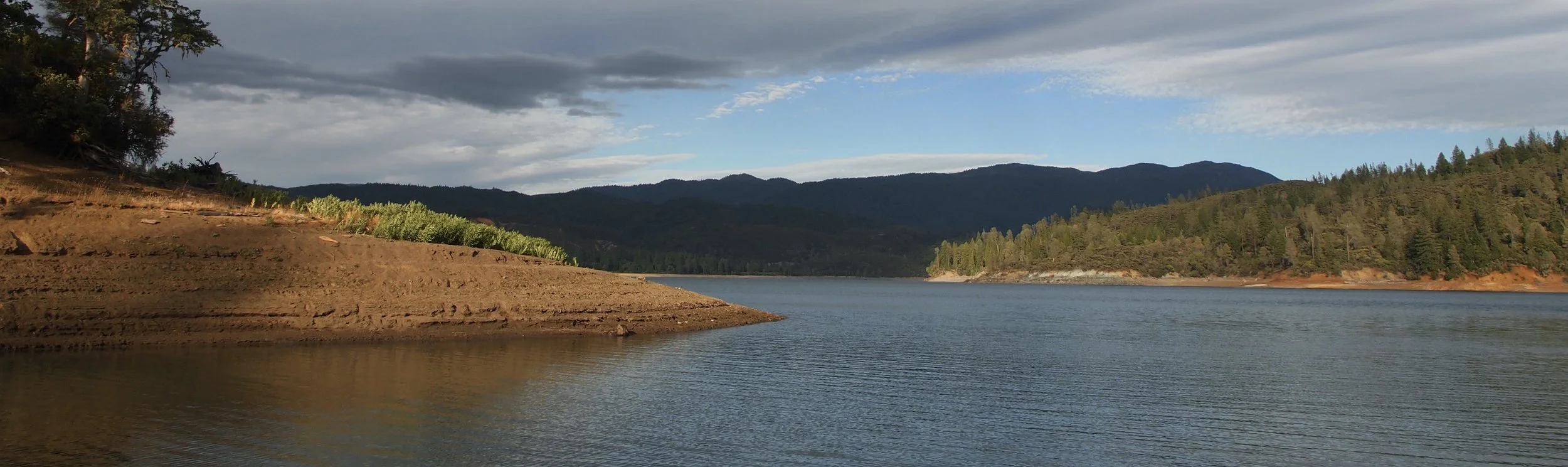
Despite 2023 starting off as a normal or above-normal water year, the spillway gates atop Scott Dam at Lake Pillsbury in Lake County will not be closed this spring or in future years. In years past, PG&E has closed the gates at the dam on or around the beginning of April, allowing lake levels to increase by as much as 10 feet above the spillway crest during the spring runoff, storing up to about 20,000-acre feet of additional water to support recreation and releases during the dry season.

For the Eel River, this means more water will potentially flow in the spring as PG&E is not storing as much water with the gates open. It also means less water will be stored in Lake Pillsbury for summer and fall water releases that support cold water fishery resources in the Eel River below Scott Dam and Russian River agricultural interests, as well as for recreation, specifically boat ramp access.

PG&E has made the decision out of an abundance of caution and in the interest of community safety.  Keeping the spillway gates open at Scott Dam from this point forward allows us to reduce potential risk around seismic performance.

As part of PG&E’s commitment to safety, the company’s team of geoscience and engineering experts regularly performs updated seismic analyses and modeling of its dams based on regional and site-specific data. PG&E also retains independent consultants to review its seismic analyses for consistency with current industry standards and practices.  New information and updated analyses suggest the level of risk around seismic performance at Scott Dam is greater than the previous evaluation.  This is not an unusual circumstance as the practice of seismic engineering and geoscience understanding of earthquake potential are continually advancing and periodic due diligence assessments on potential impacts to dams are part of PG&E’s Dam Safety Program.  

Even so, the probability of a seismic event causing severe damage to the dam remains relatively low on an annual basis (estimated to be on the order of a 1-in-900-year event).  The most effective means of reducing risk in the near term is to store less water in the reservoir and the most feasible way to store less water is achieved by leaving the spill gates open – which in years past have been closed from April through October. Mitigating risk to seismic performance by reducing the reservoir storage is an action to meet PG&E’s safety standards and those of our dam safety regulators.

“While risks to the dam remain very low, by reducing water levels in the reservoir we can mitigate against risk,” said Jan Nimick, vice president of Power Generation at PG&E. “Storing less water in the reservoir (a 26% reduction compared to a full reservoir) lowers the water load on the dam, thereby significantly reducing the risk during or after a seismic event.” 

With the dam gates remaining open, water availability will be similar to dry year conditions experienced in 2020 and 2021, when Lake Pillsbury’s spring top-off did not reach the spillway crest elevation and the project operated under FERC-approved flow variances.

The lower water levels in Lake Pillsbury will affect water customers, water availability for fishery resources protected under the ESA, and recreationists.  

“We recognize the impacts that reduced water storage in Lake Pillsbury will have. We’re committed to public and environmental safety and are committed to working closely with resource agencies and water districts to make best use of available water, as we do in dry years,” said Nimick.

Water releases into the Eel River and East Branch of the Russian River will continue as required by the Federal Energy Regulatory Commission (FERC) license for the Potter Valley Project, or by a FERC-approved flow variance. PG&E will submit a variance request to ensure Lake Pillsbury water levels are appropriately managed this year and intends to request a license amendment to modify long-term operations pending surrender of the project. These requests will involve Section 7 consultation with resource agencies to determine Eel River flows to minimize impacts to fishery resources listed under the Endangered Species Act (ESA) and PG&E anticipates a minimum flow of 5-25 cubic feet per second to the East Branch Russian River. However, the lower lake elevation will mean less water will be available this year and in the future for water users.

PG&E is developing a FERC license surrender application for the Potter Valley Project, which will address the eventual disposition of Scott Dam and Lake Pillsbury. The Surrender regulatory process allows FERC to assess all impacts of the surrender and decommissioning. The company plans to continue to develop long-term mitigation measures which could include expedited partial or full removal of Scott Dam. PG&E will continue to study and model the seismic performance of Scott Dam to better understand and manage potential risks through the surrender and decommissioning process.

Lake Pillsbury Could be Drained - Advocates See it as Indispensable

KRCB - Noah Abrams

PG&E is in the early stages of surrendering control of the Project - a pair of dams, a diversion tunnel, and a hydro-electric station along the Eel River - and some groups are hoping the surrender will result in California’s next dam removal project.

Others, not so much.

"This is a regional water issue and multiple counties are involved and it has everything to do with the drinking water in Mendocino, Sonoma, and Marin counties." Carol Cinquini, a local advocate said. "It has everything to do with fire protection in, in those counties."

"I like where I live, but it's getting hard to live here without knowing that I'm gonna have a steady water supply."

And those of the words of Frank Lynch. Both Cinquini and Lynch are with the Lake Pillsbury Alliance, a nonprofit that advocates for the lake’s preservation.

Filled 100 years ago by the completion of Scott Dam, Lake Pillsbury is in many ways the lynch pin of the Potter Valley Project.

https://norcalpublicmedia.org/2022081780728/news-feed/lake-pillsbury-could-be-drained-advocates-see-it-as-indispensable

Cutback in Eel River diversions expected to prompt new curtailments for Russian River water rights

MARY CALLAHAN

THE PRESS DEMOCRAT

August 2, 2022, 4:58PM - Updated 2 hours ago

Federal energy regulators say Pacific Gas & Electric can begin drastically reducing Eel River water diversions bound for Lake Mendocino, which will likely result in additional curtailments of water rights for hundreds of landowners, ranchers and communities in the Russian River watershed.

The new flow regime, approved last week after more than two months of consideration by the Federal Energy Regulatory Commission, authorizes PG&E to divert as little water as it did last year even though there is almost 50% more water in Lake Pillsbury than there was at the same time last year.

But PG&E is under pressure from state and federal wildlife agencies to improve conditions for federally listed salmon and steelhead trout below Scott Dam and Lake Pillsbury and, thus, is seeking to preserve a pool of cold water in the lake for release when necessary to enable fish survival.

It also told regulators that allowing the reservoir to be drawn down too much risked bank sloughing and damage.

Urban water providers supplied by Sonoma Water, which has rights to water stored behind Coyote Dam, will still have the same access to water they had last year, Principal Engineer Don Seymour said.

The agency, which supplies more than 600,000 consumers through its retailers in Sonoma and northern Marin counties, has taken measures to conserve water in the lake, including a pledge to reduce withdrawals from 2020 levels by 20% from July 1 to Oct. 31.

But many of those who rely on water from the river and its tributaries can expect to lose the right to withdraw it for the time being. New orders from the State Water Resources Control Board are expected to come out Thursday or Friday suspending water rights of a still unknown number of rights holders in the watershed.

Though not unexpected, word of the reduced river flow is widely disappointing, said Robin Bartholow, deputy executive director of the Sonoma County Farm Bureau.

“It’s not good news,” said Isaul “Junior” Macias, vineyard manager at Hoot Owl Creek Vineyards in Alexander Valley.

The federal variance allows for about a 93% reduction in flows from the Eel River into East Fork Russian River and Lake Mendocino.

“It’s really a blow,” said Elizabeth Salomone, general manager of the Russian River Water Conservation and Flood Control District in Mendocino County.

Already, nearly 600 water rights in the upper and lower Russian River have been curtailed to ensure Lake Mendocino retains sufficient storage after a third year of drought.

Newly authorized efforts by PG&E to maintain a minimum threshold in Lake Pillsbury by throttling back downstream releases from the Eel River through the Potter Valley hydroelectric plant could mean additional curtailments on the scale of last year, at least in the upper watershed, said Philip Dutton, senior water resource control engineer with the state water board. The water board staff is still crunching the numbers, he said.

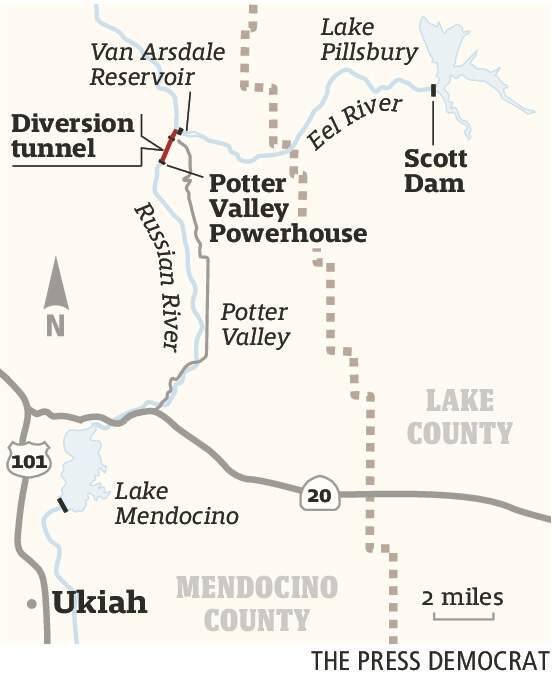
Potter Valley Powerhouse, map

Water fed through PG&E’s disabled power plant from the Eel River dumps into the East Fork Russian River and then into Lake Mendocino. Some of the resulting stream flow — up to 50 cubic feet per second under the new approval — is allocated to fulfill a contract with the Potter Valley Irrigation District.

About 5 cfs — down from around 75 cfs until now — is considered minimum in-stream flow required for environmental purposes. It’s that water and whatever return flows might accrue after the Potter Valley Irrigation District takes its allowance that is the only new water coming into Lake Mendocino at this point.

That water so far this year has kept the water level stable, said Nick Malasavage, chief of operations and readiness for the U.S. Army Corps of Engineers, San Francisco District, which oversees lakes Sonoma and Mendocino.

“We’re going to start to see the impact as the lakes starts to drop,” he said.

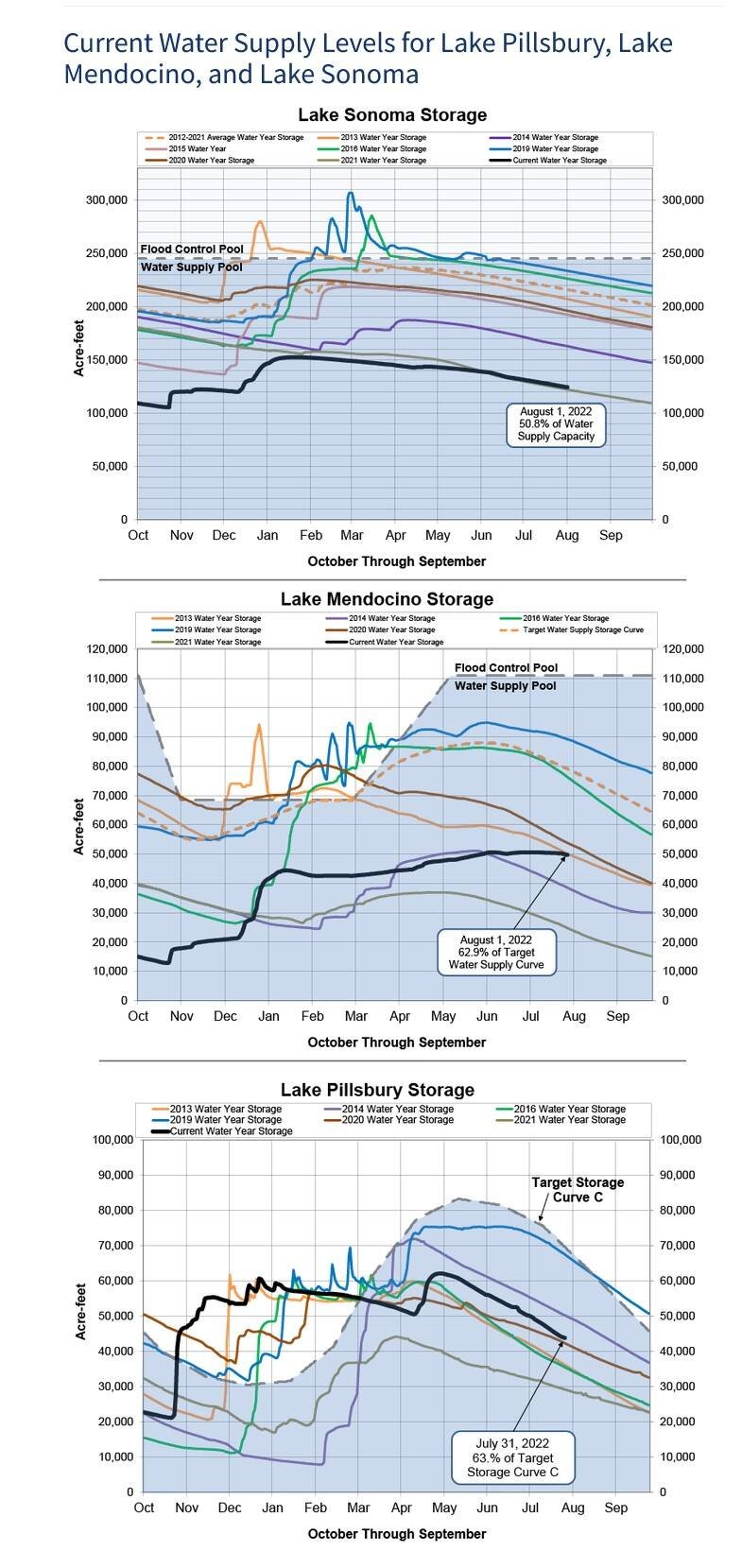
Water storage levels as of Aug. 1, 2022 in lakes Sonoma, Mendocino and Pillsbury. (Sonoma Water)

The lower flow also likely will mean the suspension, at least temporarily, of a groundbreaking voluntary water sharing agreement in use on the Russian River for the past month. It permitted participants with older, “senior” water rights that they were still allowed to exercise to share water allotments with those whose rights had been curtailed. temporarily, of a groundbreaking voluntary water sharing agreement in use on the Russian River for the past month. It permitted participants with older, “senior” water rights that they were still allowed to exercise to share water allotments with those whose rights had been curtailed.

There’s not expected to be enough water in the system now for at least some of those who had been sharing to supply even their own needs, water officials said.

Macias and Hoot Owl Creek Vineyards were among those who benefited from the water sharing after the vineyard’s water rights were among 331 curtailed in early July.

The program “went great,” he said, allowing him to see diminished acreage halfway through summer.

“Now,” he said, “going into the month of August — August, September, which are two crucial months for irrigating and getting the fruit ripe — that’s going to change everything.”

Bartholow said local agriculture stakeholders worked so hard over many months to frame the water sharing agreement with state water board personnel that to have it paused now “feels like it’s been undercut.”

“It’s just the variance (granted for stream flows) potentially made all that work moot,” Bartholow said. “The flip side of that is that this is a great model, working with the water board and the other agencies.”

Devon Jones, executive director of the Mendocino County Farm Bureau, said she hoped that conditions might allow for a bit more water in the system as time goes on, allowing more users to have access.

She said that some of those who face curtailment may have other water resources, such as storage ponds or recycled water, but the largest impact would fall on those with only one source: the river.

The curtailments allow for a minimum health and human safety allowance for those who live on land affected that she hoped would be extended for livestock.

You can reach Staff Writer Mary Callahan at 707-521-5249 or mary.callahan@pressdemocrat.com. On Twitter @MaryCallahanB.


Decommissioning the Potter Valley Project Is Off to a Rough Start

MENDOFEVER - by Sarah Reith

Decommissioning the Potter Valley hydro project is off to a rough start. There have been two developments in the ongoing saga of the Potter Valley hydropower project this week. The 20-year license has expired, but PG&E still owns and operates the project on an annual license. On Monday, PG&E submitted a rough schedule to surrender that license to the Federal Energy Regulatory Commission (FERC).

In a separate filing, PG&E argued that it should be allowed to continue operating the project under the biological protections that were attached to the license when it was issued in 2002.

The 100-year-old project consists of two dams and two reservoirs that impound water on the Eel River; and a diversion tunnel that sends Eel River water into the East Fork of the Russian River, eventually making up the majority of Lake Mendocino. At its height, the project was capable of generating 9.4 megawatts of power, but it’s not currently producing power due to a broken transformer. The project provides water that’s key to agriculture in the Russian River and has long been a hot-button issue for environmental organizations that argue it harms endangered fish in the Eel. 

On Monday, PG&E submitted a four-page proposal for a two-and-a-half-year timeline to surrender the license and decommission the project. The bulk of that time will be devoted to interacting with agencies and stakeholders as PG&E drafts more detailed documents. Environmentalists are pushing for a speedy removal of both dams. But PG&E spokeswoman Deanna Contreras said in an email, “We expect it will take many years following PG&E’s submittal to FERC for a Decommissioning Order to be issued.” She added that PG&E still plans to replace the broken transformer, expecting it to amortize over a period of five years. Replacing the part could take up to two years.

Water-using stakeholders include the Potter Valley Irrigation District, which has contractual rights to some of the water; and the City of Ukiah, which has pre-1914 rights to water further down the East Fork, before it flows into Lake Mendocino. The Sonoma County Water Agency claims the bulk of the water in the lake. The Russian River Flood Control and Water Conservation Improvement District also has water rights to the lake, and sells wholesale water in Mendocino County. All these interests are currently in suspense about whether or not PG&E will be allowed to drastically reduce the water flowing through the diversion tunnel. PG&E has stated that one of its reasons for asking FERC to allow it to cut down on the flows is to preserve a cold-water pool for young salmonids in the Eel River.

But it’s not just environmental advocacy organizations that are concerned about the project’s impact on wildlife and the environment. Back in 2002, the National Marine Fisheries Service, or NMFS, wrote a Biological Opinion, laying out the measures that PG&E needed to take in order to comply with the Endangered Species Act. That opinion was incorporated into the license that was issued at that time, and which expired three months ago.

In March of this year, NMFS wrote a letter to FERC, saying that the project was causing take, or killing and harming fish that are listed under the Endangered Species Act, “in a manner not anticipated in the Opinion and from activities not described in the Opinion.” The letter goes on to say that the fish passage facility at Cape Horn Dam has not undergone the proper consultations regarding endangered species, and that none of the operations at the facility are covered in the 20-year-old opinion. NMFS wants to re-open consultations about the license in order to update and strengthen the environmental protection measures. This means that the license for the project would be undergoing amendments at the same time that it is being surrendered.

Within a few weeks of the NMFS letter, environmental advocates filed a notice of intent to sue PG&E under the Endangered Species Act, citing among other things that the fishway at Cape Horn Dam made the fish easy prey for river otters.

In a 16-page letter to FERC, PG&E wrote that NMFS doesn’t have evidence to back up its claims. PG&E also protested that NMFS failed to mention “any of the voluminous monitoring record covered by over 20 years of monitoring Project operations.”

Redgie Collins is the legal and policy director for California Trout, one of the organizations arguing that PG&E is in violation of the Endangered Species Act. He believes the biological opinion expired along with the license, and that it needs to be updated. CalTrout is threatening litigation as part of a pressure campaign to speed up dam removal and install other structures that will enable a winter diversion from the Eel to the Russian. “We have plenty of information that shows that these 100-year-old plus Eel River dams kill fish,” he declared. “And becasue they kill fish, and because we believe that the Biological Opinion has ended, that PG&E is required to either re-consult, or open themselves up to litigation that we are preparing, as we speak.”

Collins is inspired by plans to remove four hydropower dams from the Klamath River, which is scheduled to start next year. “It took them about 18 years to get to the point of the surrender process,” he said. “And once it kick-started there, the writing was on the wall for the eventual solution, which was worked on by a host of stakeholders, including tribal nations. Here we have a very similar path, and so we’re hoping that they use the existing information that we’ve put forth, and the removal plan, and try to beat that 30-month window. That’s our goal. It will never be quick enough for us.”

The Round Valley Indian Tribes have weighed in on the NMFS request to amend the license, saying the tribes support all the protective measures proposed by the service. The tribes are one of the few entities PG&E notified of its intent to reduce flows coming through the project, much to the chagrin of the Russian River water users, who argued that PG&E should have assembled a full drought working group before asking FERC to sign off on the reduction, or variance.

Collins says PG&E could have cut down the flows any time, without waiting around on FERC. “If they truly wanted to save listed species, they would have implemented the variance,” he said. “That cold pool will be functionally gone in a short period of time. We think just in a matter of weeks that cold pool will be drained based on the variance not being implemented.”

With ag users writing angry letters pleading for more water and environmentalists threatening lawsuits, one thing is clear: the initial outreach to stakeholders is not going well. And the decommissioning process hasn’t gotten started yet.

Eleven miles of Eel River corridor, Lake Pillsbury basin protected under conservation easement

THE PRESS DEMOCRAT

BY MARY CALLAHAN

Between talk of a widely reviled Coal Train and continued uncertainty over Pacific Gas & Electric’s Potter Valley hydroelectric plant, the future of the Eel River has been a source of profound anxiety over the past year.

But there’s some good news with the announcementthat 5,620 acres of remote wilderness along 11 miles of the river between Lake Pillsbury and the Potter Valley Project are now permanently under a conservation easement held by the Mendocino Land Trust. The easement includes the Lake Pillsbury basin and shoreline, as well as the property around the power plant, in addition to what the land trust describes as “a wide area on either side of the river” in proximity to the Mendocino National Forest.

The arrangement prohibits future subdivision and development on the land, protecting natural habitat for chinook salmon and steelhead trout from degradation, as well as supporting bald eagles, osprey and elk often seen around the lake.

PG& E will still own the land, which is part of a complex system. Eel River water is stored behind Scott Dam in Lake Pillsbury, delivered downriver to Van Arsdale Reservoir and tunneled through a mountain to turn the turbines in Potter Valley before it transfers to the East Branch Russian River and Lake Mendocino.

But with PG& E’s decision in 2019 not to renew its operational license, changes are afoot for the entire system, including the permanent closure of the power plant and the potential removal of Scott Dam.

Having a land organization in charge of stewardship before those decisions are made was a comfort to Alicia Hamann, executive director of Friends of the Eel River.

“I would trust a land trust to manage the land more responsibly than PG& E,” she said.

Importantly, the easement provides for public access to the river and lake basin in perpetuity, which is one of the most exciting things about it, said Conrad Kramer, Executive Director of the Land Trust.

Often, conservation easements exist on private land that prevent development but don’t otherwise benefit the public. This one is special, particularly given the popularity of Lake Pillsbury and surrounding areas. The newly protected acreage includes several campsites, including the Trout Creek campground east of the powerhouse.

But, in general, the land “feels remote and it feels very wild,” Kramer said.

The agreement is the result of a nearly 20-year process that began with the settlement of PG& E’s 2001 Chapter 11 bankruptcy filing. (The company recently emerged from a second round of bankruptcy proceedings begun in 2019 because of billions of dollars in liability from catastrophic wildfires.)

The 2003 settlement included a provision that required the company to dedicate 140,000 acres of watershed land worth $300 million around its hydroelectric facilities to be used in perpetuity for public purposes.

The nonprofit Pacific Forest and Watershed Lands Stewardship Council was established in 2004 to oversee that effort. It reached out about a decade ago to the Mendocino Land Trust to negotiate an easement, Kramer said.

PG& E paid for the staff time and any studies needed during the negotiations, and also provided more than a half-million dollars to fund a stewardship endowment, he said.

“We’re really happy about it,” he said.

The land trust also holds a conservation easement on 879 acres of adjoining forest on the north side of the river donated by PG& E to the Potter Valley Tribe in 2019, restoring a portion of the tribe’s aboriginal territory.

Close to 1,000 acres also has been donated to the U.S. Forest Service.

The patchwork of easements and public lands contributes to expanded wildlife corridors, as well.

Most people who visit the affected stretch of river at this point actually go in the river, Kramer said, but he said he hopes to see hiking trails in the future that might enhance public enjoyment of the area.

And if, at some point, the lake goes away, the land underneath would be cared for by the land trust, he said.

“The whole area underneath the water here would be under our easement,” he said.

You can reach Staff Writer Mary Callahan at 707-521-5249 or mary. callahan@pressdemocrat. com.

Destroying Lake Pillsbury Is An Expensive Gamble With Our Water Supply

Destroying Lake Pillsbury Is An Expensive Gamble With Our Water Supply

“The prospect of the Russian River going dry as it runs along the Mendocino-Lake County line into Sonoma County is frightening, especially in the age of megafires that our region is experiencing. The Eel River in Lake County may go dry and without the water in Lake Pillsbury and Lake Mendocino the regional wildfire danger would seem only to be further heightened.

There have been many assumptions made by dam removal proponents, including that the regional water supply would not be threatened; that the cost to remove the dams is cheaper than providing fish passage; and that the environmental impact on Lake County is minimal. These assumptions simply do not hold up when the broader context is considered.”

Russian River Water Users Could See Significant Curtailments After PG&E Requests Flow Variance

MENDOFEVER - JUNE 2, 2022

By Sarah Reith

Russian River water users are preparing for another dry year, with water rights curtailments for those who depend on Lake Mendocino, and the possibility of just a trickle coming out of Lake Pillsbury.

PG&E, which still owns and operates the Potter Valley Project under an annual license, has asked the Federal Energy Regulatory Commission (FERC) to give it permission to release five cubic feet of water per second from Lake Pillsbury into the East Branch of the Russian River, which flows into Lake Mendocino. This is a variance from the 75 cubic feet per second that’s otherwise required for this time of year.

Elizabeth Salomone, the General Manager of the Russian River Flood Control and Water Conservation Improvement District, says that although last year’s variance was the same, water managers were expecting five times as much this year. That was based on the storage levels in Lake Pillsbury, which filled during winter storms, and the terms of the license. “In other words, the request for five cfs is a significant change from the current license,” she asserted; “and I believe there will be questions. What is the justification for that great change, from the expected 25, based on conditions, and what they’ve asked for. The five.”

Last year, PG&E aimed to have 12,000-acre feet in Lake Pillsbury by the end of the water year in the fall. This year, after consulting with the Round Valley Indian Tribes and state and federal regulators, PG&E wants to make sure it maintains at least 30,000-acre feet in the reservoir. That’s to create cold water pools below Scott Dam, for the benefit of endangered salmonids.

Alicia Hamann, the Executive Director of Friends of the Eel River, says it’s time to face the facts of water scarcity. “I think that makes it eight of the last ten years that they’ve required a variance to operate the project,” she said; “and it’s just really telling that the status quo is not sustainable… It’s not sustainable for the interests in the Eel River, nor for water users in the Russian River. And I think seeking a new future for the (Potter Valley) Project and for the Pillsbury Basin is just in the interests of everyone.”

In a letter to FERC, PG&E wrote that if it has to continue releasing 75 cubic feet per second, Lake Pillsbury will be drawn down so low that its banks could be destabilized, which could affect the safety of Scott Dam.  Janet Pauli, of the Potter Valley Irrigation District, expects the District to continue getting its 50 cubic feet per second on demand; “but the minimum instream flow going to five without a buffer is a dramatic decrease…If we start the year off as a dry year, that would give us a 25 cubic feet per second buffer, and then what we believe is they should watch the lake level carefully. If it gets to a point where it drops too precipitously, they could incrementally reduce the diversion rates through the Project.” 

The irrigation district also submitted a letter to FERC, complaining that PG&E had not consulted with a full range of stakeholders before requesting the variance. Last year, FERC required PG&E to consult with a drought working group to have the same variance approved.

In its proposal to FERC, PG&E wrote that it does plan to reconvene the drought working group, but if the full group is unable to agree on flow adjustments, the determination will be settled on by the Round Valley Indian Tribes, the California Department of Fish and Wildlife, and the National Marine Fisheries Service. The letter also says that according to the contract with the Potter Valley Irrigation District, PG&E has the discretion to limit deliveries.

The district differs on that interpretation, writing that it’s still entitled to 50 cubic feet per second, but that it’s been requesting less water to conserve the infrastructure at Lake Pillsbury. And the district declares that the new minimum storage target of 30,000-acre feet “is not supported by any definitive studies or modeling of prior year conditions and is clearly outside of the existing license requirements.”

Salomone says the variance would have a significant impact on water users further downriver, too. “That 25 cfs that was expected would satiate some of the demand for the appropriative rights along the Upper Russian River,” she explained. “The Flood Control District has one of those appropriative rights. But so do many others, including urban water suppliers and agriculture. At five cfs, preliminary analysis is that the State Water Board would need to curtail all post-1914 water rights. The water rights system is based on priority dates, so the older your water right, the higher priority. It will cause curtailments to go back as far as 1914, and possibly earlier.” 

Salomone does expect some minor differences between this year and last.  “This year it does protect an amount for human health and safety for all urban water users and domestic diversions,” she said. “And there is a small amount for the highest priority appropriative water rights. Last year, the State issued full curtailments. No appropriative rights or riparian rights were able to pump. They were all curtailed. So it’s a tiny, tiny bit better this year. But a very, very small amount of better.”